
Rain, Rain, Go Away
Joel D. Panes — August 13, 2026
Rain, Rain, Go Away
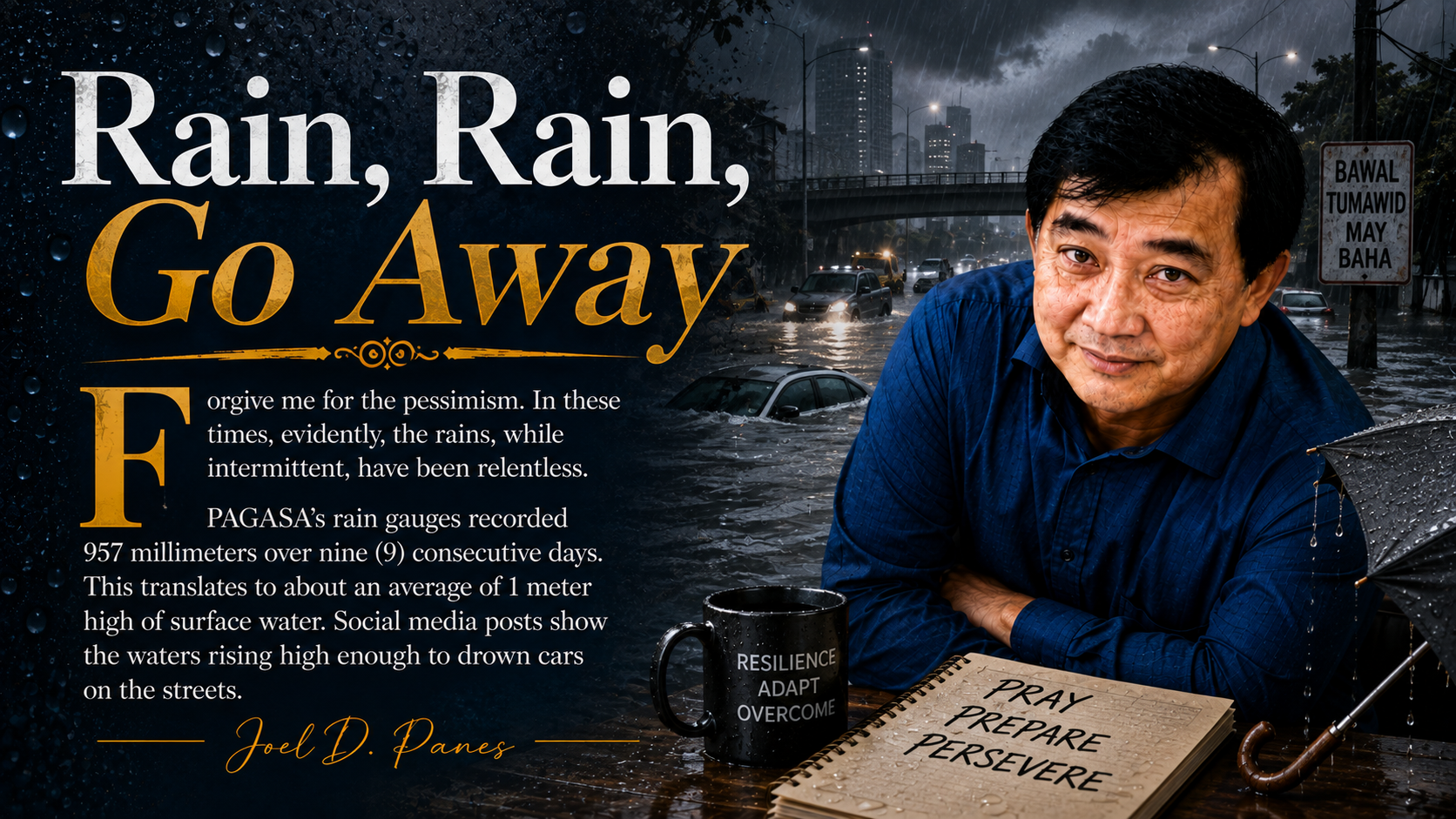
“Rain, rain, go away” is a familiar nursery rhyme that most, if not all, of us sang at some chapter of our lives. When and by whom exactly the rhyme was composed remains unknown. But archives show that sometime in 1659, James Howell, a British historian and diplomat, recorded something similar: “Rain, rain, go to Spain, fair weather come again.”
Some twenty years later, the earliest recorded version was modified. In John Aubrey’s collection of nursery rhymes, “Rain, rain, go away. Come again a Saturday” was found. Nowadays, Saturday has become another day.
After the torrential rains brought by the combined forces of Typhoon Maymay and the Habagat left many parts of Luzon flooded, the short song taught to toddlers has become a wish in futility.
Forgive me for the pessimism. In these times, evidently, the rains, while intermittent, have been relentless. PAGASA’s rain gauges recorded 957 millimeters over nine (9) consecutive days. This translates to about an average of 1 meter high of surface water. Social media posts show the waters rising high enough to drown cars on the streets.
The sun has not been as kind to ward away gray nimbostratus clouds between its golden slivers and good warm day. Modern science attributes nature’s mischief against the comforts of earth’s inhabitants as climate change.
Or was it likely, in those years behind us, the grass really was greener?
Yes sir, there were more trees and vegetation which covered our land. We had more green territory. Forest cover acts as a natural sponge. Water is directed to natural underground streams. Moreover, the trees’ roots bind the soil together and protect it from erosion.
Not as green anymore. In 2020, only 23.4% of Philippine land, or about 6.91 million hectares, remained forested. Fifty (50) years ago, there was 10.9 million hectares of forest cover or 36.3% of the land. or about 10.9 million hectares. In half a century, 37% of forest cover was lost. There may not be a green, green grass of home anymore. Our mother land is slowly transmogrifying into a possible candidate state of Kevin Costner’s 1995 Waterworld.
In the good old days, were times kinder? Or were men more better? Decades ago, marriage was a truly hallowed institution. Nowadays, the ancient spiritual tradition joining man and woman in an sacred bond is endangered - as forests and the monkey eating eagle. Congress and certain civil proponents are itching to pass a general divorce law, although in Philippine law, legal remedies are already available to nullify marriages.
Have changing times introduced changing values, even climate change? Who wants to draw the connection? Or was there always a connection? Bible readers will echo an apostle’s 2000 year old letter to his disciple, Timothy. “For people will be lovers of self, lovers of money, proud, arrogant, abusive, disobedient to their parents, ungrateful, unholy, heartless, unappeasable, slanderous, without self-control, brutal, not loving good, treacherous, reckless, swollen with conceit, lovers of pleasure rather than lovers of God, having the appearance of godliness….”
We are pointed to climate change, nature’s mischief as the culprit as Hemingway characterized the seas are like women - mystically beautiful when peaceful, but in certain episodes, wicked and unrelenting as an adversary. But there is rabid silence regarding accountability. The forest have been unconscionably exploited. The naturally installed barriers and mechanisms controlling monsoon rains were compromised.
Yes, taxes injected life blood to the economy. And the downward trend of deforestation? With the same taxes collected from logging and mining operations, damages and destruction inflicted by seasonal floods are funded. Whatever the economic trade off is, the onus is paid by the suffering taxpayer.
Now, think of the coming of Pax Silica. The government earmarked 1620 hectares of land will be used. For the promise of jobs and the taxes revenue benefiting government, the diminishing forest covers, ravaged in the last 50 years, again, will be further reduced. Precious watersheds to naturally quench thirsty millions will be disturbed.
Rain, rain, go away? Perhaps not anymore. Times, climate and values have changed. For the incessant rains, are the nurseries rapping Gloc9’s “Upuan?”